

August 31, 2026
Why Personal Cyber Health Is Family Office Cybersecurity
By Jeremy Banon, Founder & CEO
← Back to The Cyber Health Journal
Family offices operate at the intersection of significant wealth and personal exposure. While many have invested in enterprise-grade security through Managed Security Service Providers (MSSPs), a critical vulnerability remains unaddressed: the “cyber-selves” of the family and their employees. We believe that personal cyber risk is family office risk. An adequate security program requires a focus on personal identity, accounts and devices that MSSPs may not cover. This article outlines the evolving threat landscape, explains why traditional enterprise security falls short and describes how a partnership with The Cyber Health Company fills this gap.
MSSPs Neglect Personal Risk, Which is Family Office Risk
By most measures, family offices are enterprises. They are incorporated, manage substantial assets, employ teams and handle sensitive information. It is a reasonable conclusion to engage an MSSP to protect the entity, manage risk, monitor for threats and respond to incidents.
But family offices are unique. The boundary between corporate and personal is inherently blurred. They ARE the corporation. This is not a security failure or oversight. It is how family offices function. Family members operate across both spheres simultaneously, using personal accounts for time-sensitive coordination, maintaining relationships through personal communication channels and accessing family office systems from devices that serve dual purposes. The overlap is unavoidable.
MSSPs are designed to secure the corporate perimeter. They protect family office email domains, monitor corporate networks and manage cloud infrastructure. What falls outside that perimeter is everything tied to personal identities: personal email accounts, consumer cloud services, individual financial accounts, social and the digital footprints that connect family members to one another. More specifically, products like Gmail, Instagram, Smart TVs, Claude, Venmo and more are used by wealthy individuals, carry risk but are not covered by MSSPs.
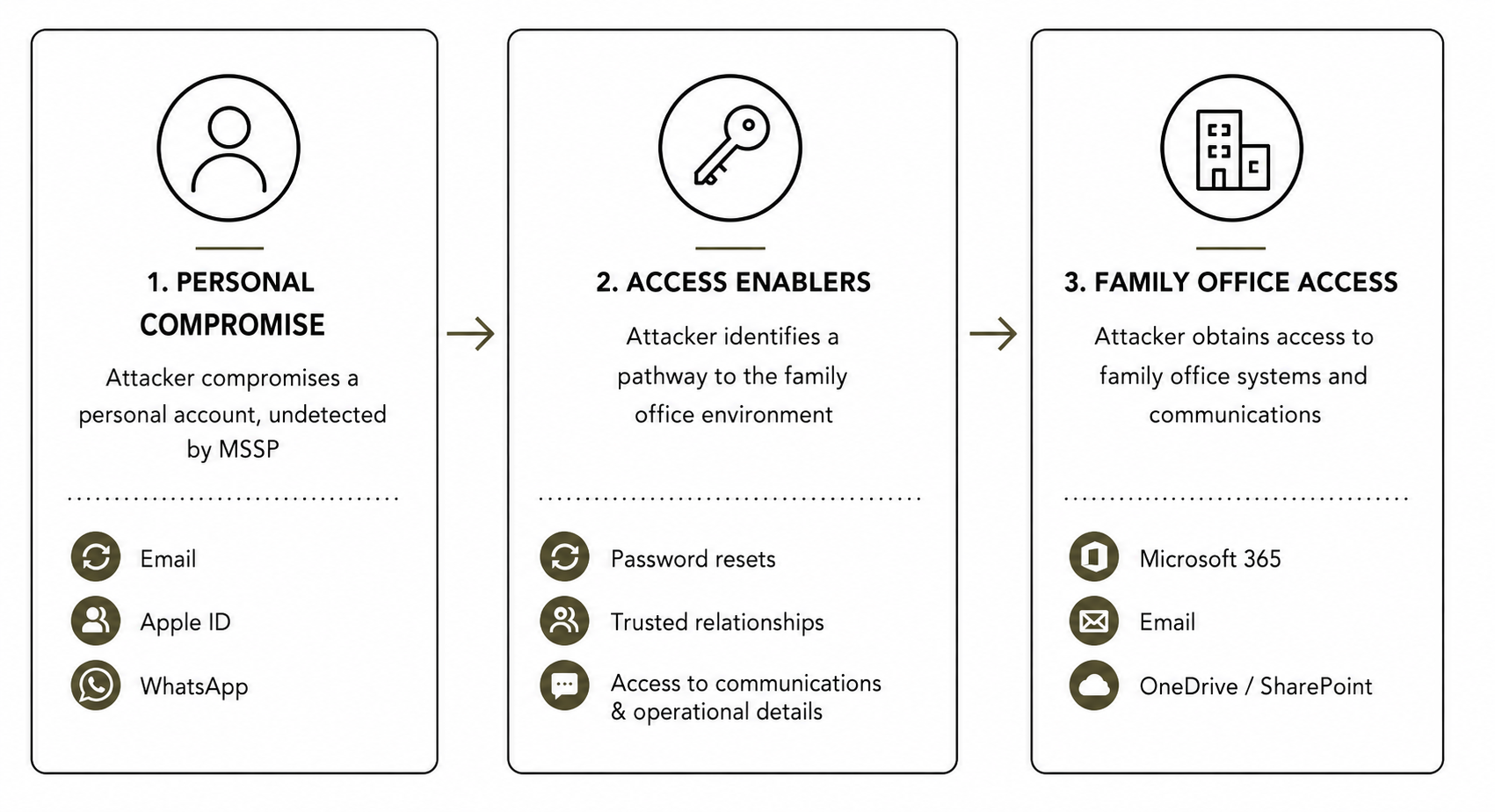
This gap creates a direct attack path. Compromise of a personal account can yield credentials to family office systems through password resets, trusted relationships or access to communications that reveal operational details. From there, lateral movement into corporate systems is often straightforward. The attacker does not need to compromise the enterprise when personal accounts already holds the keys. Lateral movement from personal -> enterprise environment well understood with our corporate customers.
With AI, Attackers Have Gotten Better. Have you?
Frequency of personal attacks have accelerated. In part, this is is because attackers now leverage open source AI to:
- Prospect at scale: AI tools automate the collection of personal information from social media, data breaches, and public records, building detailed profiles of high-net-worth individuals in minutes.
- Craft precise attacks: Generative AI enables highly personalized phishing messages that mimic trusted contacts, reference real events, and bypass traditional email filters.
- Operate with speed: Automated attack infrastructure allows bad actors to test thousands of variations simultaneously, increasing the likelihood of success.
Here is an actual attack shared with us by a family office we did not yet work with (name changed):
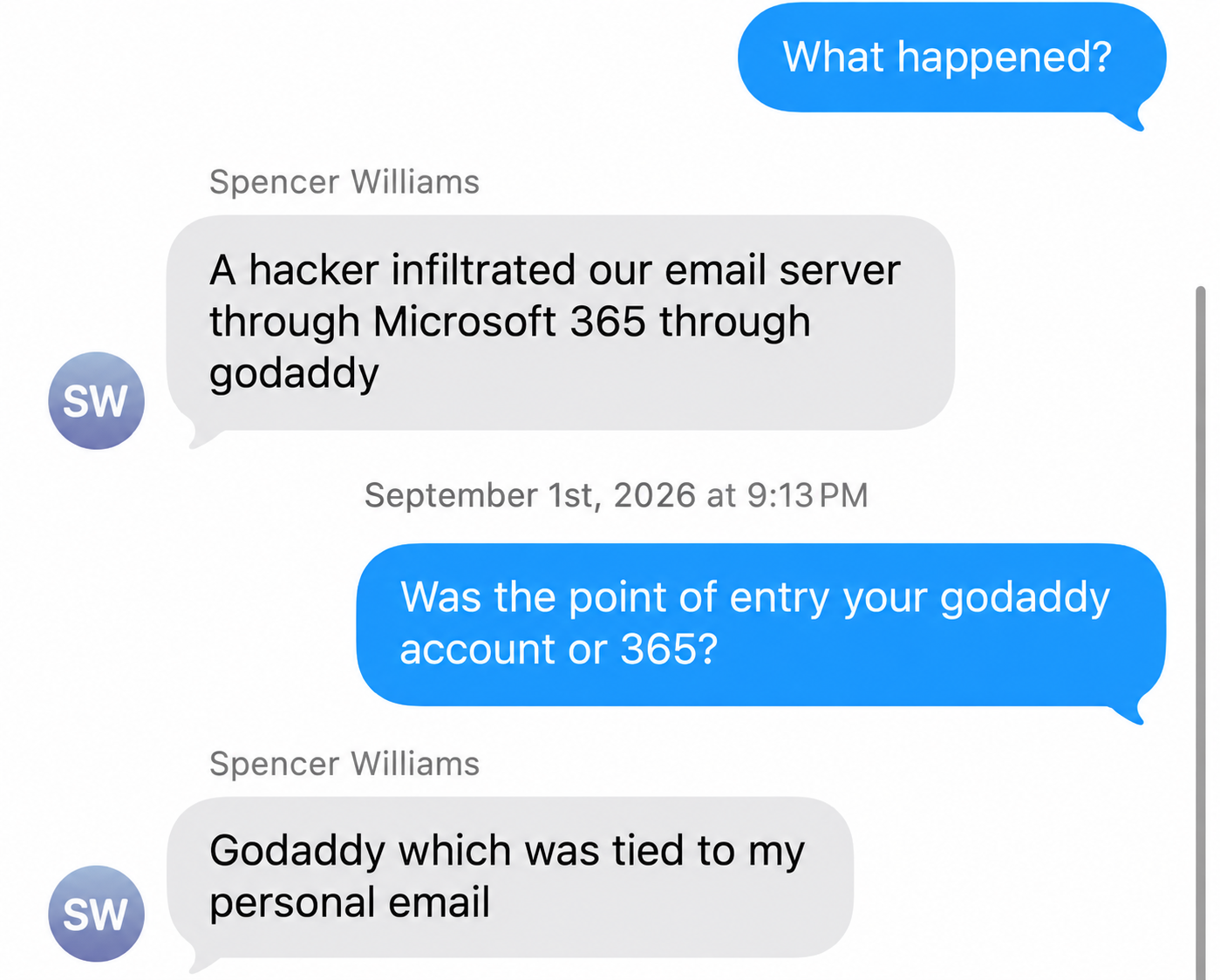
The attackers have gotten smarter, faster, and more precise. If a family's cybersecurity practices have remained unchanged over the past few years, their risk profile has not. Decades of personal security debt is coming due.
Cyber Health Augments Traditional Security Programs
Partnering with The Cyber Health Company complements, not replaces, your MSSP. It focuses on the personal accounts, devices, and behaviors that fall outside enterprise monitoring. The goal is proactive risk reduction: identifying vulnerabilities before they are exploited and implementing practical protections that travel with the individual, not just the corporate network.
Key areas often neglected by enterprise security:
Tech literacy agnostic. One concern we hear from family offices is that cybersecurity programs require technical expertise to implement and maintain. That should not be the case. A well-designed Cyber Health program meets families where they are, providing clear guidance, managed services, and ongoing support that does not assume deep technical knowledge. The family should focus on their priorities; the Cyber Health program handles the rest.
Conclusion
Family offices deserve security that matches their unique structure. Enterprise protections are necessary but insufficient. By adding a personal Cyber Health layer, family offices close the gap between corporate security and personal exposure. This keeps them ahead of threats that MSSPs do not address, with protections that work regardless of technical sophistication.
The question is not whether personal risk matters. It is whether your security program reflects that reality. Book a demo today with our team to learn how we can support your family office.
Jeremy Banon is CEO of The Cyber Health Company, a personal cybersecurity and online privacy company for executives and high-net-worth individuals.